Tick Bites and Diseases - Vienna Health Officer - June, 2019

Tick Bites and Diseases
Dan Onion, MD, MPH
Mt. Vernon/Vienna Health Officer
293-2076; dkonion@gmail.com
June, 2019

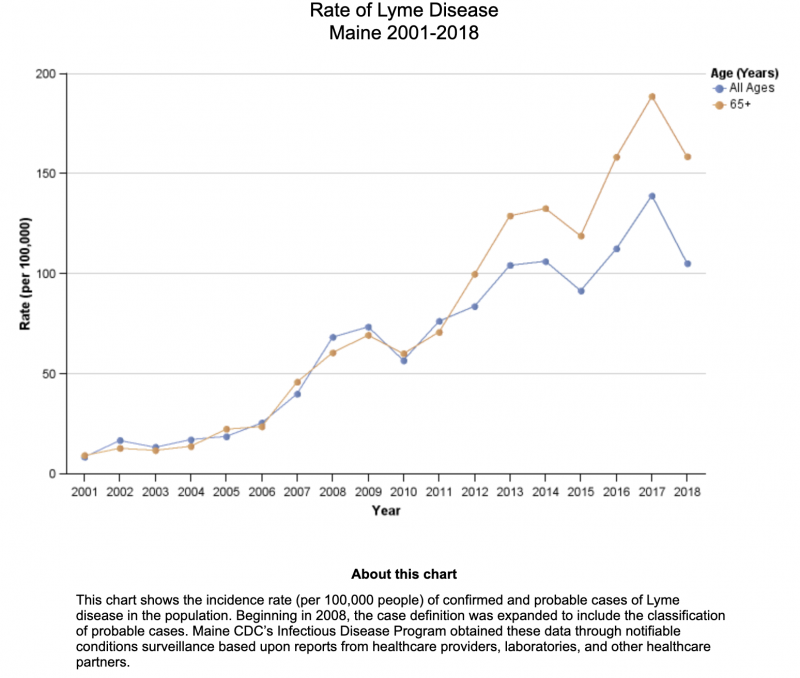
I just pulled the 5th tick of the year off my leg last night! It hadn’t embedded yet; rather it was racing up my leg to hide, tripping over my hairs and so alerting me. It reminded me that I haven’t written about ticks and the diseases they transmit in these columns since 2013! Time to review again, given that circumstances have worsened since then (Fig. 1).

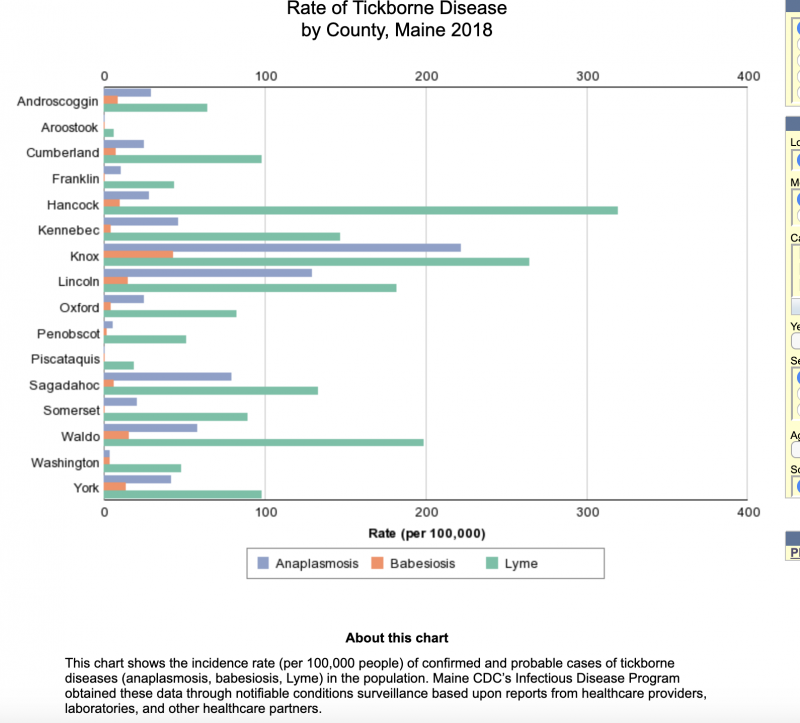
Deer ticks cause Lyme disease by transmitting Lyme bacteria when they attach to their animal/human victim. They can also transmit the less common diseases (Fig. 2), anaplasmosis and babesiosis, and rarely several others (ehrlichiosis, rocky mountain spotted fever, and others Maine used to be on the edge of the deer tick/Lyme disease infestation area, the southern New England states. But with long term warming and less winter kill, ticks and deer populations have increased substantially, so it is now much more common to see tick bites and consequently increased Lyme disease incidence, especially along mid-coast Maine (Fig. 3).

Lyme disease gets its name from the coastal town of Lyme, Connecticut. In 1975, a woman reported to Yale researchers 51 local cases of pediatric arthritis, which they identified and named “Lyme arthritis".  In 1979, the name was changed to "Lyme disease" when other researchers discovered additional symptoms linked to the disease, including neurological problems and severe fatigue. In 1982 the bacteria causing the disease was discovered by Dr. Willy Burgdorfer, hence its name: Borrelia burgdorferi.

There are two common types of ticks here in Kennebec County: deer ticks, 5% of which are carriers of Lyme disease, and benign dog ticks. Deer ticks are half the size of apple seed-sized dog ticks, and lack the latters” white "racing stripes" down their backs. However, deer tick nymphs (babies), are more common this time of year, and are as small as poppy seeds, that is until they attach to people or animals and fill with blood to 10 times that size over several days. The longer a deer tick stays on, the more likely people are to contract Lyme disease, if the tick is a carrier. If they embed for fewer than 24-48 hours, disease rarely follows; most patients with Lyme disease have had a tick on for nearly a week.

Three to thirty days after a bite, the first sign of disease is usually a circular (usually over 3 inches in diameter), non-tender rash, called erythema chronicum migrans (EM), which looks like a red "ringworm" rash around a bull’s-eye bite site. The rash occurs in  70- 80% of patients.  In Maine, EM is reported in just over 50% of patients. But don’t be alarmed about the small mosquito bite-like red spot appearing at the site of the bite itself within a day or two; it just reflects the bite injury, not a Lyme infection. Fever in 60% of patients, aching body and joints (90 + %), and headache (65%) also occur as the rash reaches its peak and begins to fade. If not treated, complications involving heart, nerves, brain, and joints can occur weeks and months later. Children 5-14 and people over 65 have these the most frequently. However, Lyme disease is almost never fatal, unlike the other rarer tick-borne diseases.

So how can you avoid these troubles without moving to Northern Canada? First, the most important thing to do is use DEET-containing bug dope to discourage their climbing on you, and tucking your pantlegs into your sox, a popular new Maine fashion now. Secondly, you should check yourself and your family for ticks daily if they’ve been outside whenever the ground isn’t frozen. This can be hard on parts of the body difficult to see, like the back side of your knees or trunk. I thought I'd grown a big skin tag behind my knee for several days, until I looked with a mirror and saw it was an engorged (swollen) tick not a big blueberry! Yikes! And wash, or at least heat in a dryer, clothes worn outside that may or do have ticks on them. Keeping your lawn mown may help by giving ticks less chance to climb up higher to jump on you; and some say light colored clothing helps, but I doubt the evidence basis for that.

If you find a tick, it's not swollen, and you are pretty sure it hasn't been on for more than a couple days, there is no need to submit it to the state lab for identification or be treated; just remove it and your chances of developing disease are very small. Slow steady pressure to pull it off usually works. The best instrument for this is a “tick spoon”, a baby spoon sized tool with a split down the middle to scoop up the trapped tick. Use tweezers to pull steadily but gently for the several minutes it takes to get the tick to release; I prefer a Leatherman for the revenge satisfaction. Breaking the head off in the bite leaves some, though substantially less, risk of infection. Don't try to burn the tick off; it may be tougher than your body will tolerate.

If the tick is engorged and may have been on for several days, then call your doctor/clinician for a single preventive dose of doxycycline. It will reduce your chances of getting Lyme from an infected tick from 3% to 0.6%.

If you develop the ring rash around the bite site weeks later, or in a place where you weren't aware you'd been bitten, then you should be given a course of antibiotics for 2-3 weeks, doxycycline/tetracycline for most, amoxicillin or cefuroxime for pregnant women and children, in whom the tetracyclines are not safe. The downside of the latter alternative antibiotics is that they don't also cover the rare co-infections with ehrlichiosis, anaplasmosis, and babesiosis. You will probably need to see a doctor/clinician to evaluate any such rash; ask for an urgent appointment. Sooner rather than later treatment is important. The rare, late complications are also treated with antibiotics after being proven due to Lyme by blood test immune titers.

So, use bug dope. Check yourself and the kids. Pull ticks off before they get engorged. And get antibiotics if you develop the characteristic rash or other symptoms.

For more information about ticks and many other public health risks, check out the Maine CDC portal here  and their great section on ticks : here
Marti Gross


Martha Gross (1946 - 2019)


Martha Gross, 72, of Vienna, died Sunday May 19, 2019, at Maine General Medical Center in Augusta.

She was born in Methuen, Mass., Sept. 29, 1946, the daughter of John and Marguerite (McCarthy) Casserly.

Martha graduated Emmanuel College in 1968. She worked for many years at her husband's dental practice and more recently as the treasurer for the towns of Vienna and Mt. Vernon. Her passion for volunteering started at an early age as a candy striper and followed her later in life as she gave her time to numerous organizations and causes, such as the Union Hall Association.

Martha was predeceased by her husband, Lawrence Gross.

She is survived by her children, Michael Gross and his wife, Elizabeth, of South Portland and Rebecca Gross, of Cambridge, Mass.; her grandchildren, Jacob and Caileigh Gross of South Portland; her sister, Marie Schena and her husband, Bobby, of Haverhill, Mass., as well as several nieces and nephews.

A memorial service will be held at the Union Hall in Vienna, Maine, at 11 a.m., on June 1.

Arrangements are in the care of Knowlton and Hewins Funeral Home, One Church Street, Augusta. Memories, condolences, photos, and videos may be shared with the family on the obituary page of our website at www.familyfirstfuneralhomes.com


Planning Board Meeting - February 27, 2019

MINUTES OF THE REGULAR MEETING OF THE VIENNA
PLANNING BOARD HELD FEBRUARY 27, 2019

The meeting convened at the Town House at 7:00 PM. Regular members present were Waine Whittier, Alan Williams, Creston Gaither, and Ed Lawless. Minutes of the January 23 meeting were read and accepted.

Creston had advertised tonight’s meeting as a public hearing on changes to the Shoreland Zoning Ordinance (SZO) required by DEP (see January minutes). No public citizens appeared.

The Board voted 4 – 0 to move forward with putting the said SZO changes before the Town at the March Town Meeting.

The meeting adjourned at 7:20 PM.

Creston Gaither, secretary

Local Events


Save the first weekend of Fri. Aug 2 and Sat. Aug 3, 2019

 For the Vienna Woods Players performance of “The Musical Comedy Murders of 1940”. 

Three performances: 7pm on Friday and 2pm and 7 pm Saturday.
And if you are interested in applying to be part of the cast, contact Cheryl Herr-Rains 207-293-3967.

Planning Board Meeting - January 23, 2019

MINUTES OF THE REGULAR MEETING OF THE VIENNA
PLANNING BOARD HELD JANUARY 23, 2019

The meeting convened at the Town House at 7:00 PM. Regular members present were Waine Whittier, Alan Williams, Creston Gaither, Ed Lawless, and Tim Bickford. Minutes of the December 26, 2018 meeting were read and accepted.

Waine’s draft Annual Report was briefly reviewed and approved.

DEP’s letter of July 26, 2018 was reviewed. Waine will ask MMA whether we need a Town
Meeting vote to amend the Shoreland Zoning Ordinance to include certain measures that the
letter indicates are already in effect and binding on the Town and any applicants.

The meeting adjourned at 7:20 PM.

Creston Gaither, secretary

Influenza This Year in Maine - Dec. 2018

Influenza This Year in Maine

Dan Onion, MD, MPH

Mt. Vernon/Vienna Health Officer

293-2076; dkonion@gmail.com

December, 2018

Winter is coming and so is influenza. Last year we had a bad year and there was a lot of bad press about immunizations, so let's review this annual epidemic and what we know so far this year.

Influenza is an infectious disease of the upper and lower respiratory tract (nose, throat, breathing tubes and lungs themselves) caused by an influenza virus. Two major types of influenza infect humans, A and B.  "A" types cause most of the disease, injury and death; "B" types are less common and more benign, but are still hard on, and sometimes fatal, to babies and the elderly. Influenza viruses survive over the centuries because they change their coat every few years. Those are, on Type A viruses, surface proteins called hemagglutinin (H) (with subtypes 1-5), and neuramidase (N) (subtypes 1 and 2), against which our bodies make effective antibodies when we are infected or immunized. By changing those coat proteins through genetic natural selection every few years, the slightly different flu virus becomes more infectious because people haven't been previously exposed to that version.

To treat this common disease, boost your family's immunity with a flu shot every year, so none of you catches it or maybe get only a mild case. Years, when most of us have already been infected by and/or immunized against the circulating H/N combination types, cases of illness are fewer and less severe. The US Centers for Disease Control (CDC) makes an educated guess each year about which recent subtypes are going to predominate, and incorporates 3 or 4 of those into vaccine manufactured each fall. The vaccine is egg-based, so the rare person who is truly egg protein allergic (I’ve never met one), can’t take the shot and must use available alternative vaccines.

When the virus changes its coat, as it always does, and/or the US CDC hasn't guessed right, and/or we haven't done a good job of immunizing everybody, then we have worse epidemics. Their severity is usually measured by elementary school absence rates over 20%, higher than average emergency room and office visits for "influenza-like" illnesses, hospitalizations, and deaths.

When given the standard shot into our arm muscle, most of us do fine, suffering at most a mildly sore arm for a day or two. Many claim to have “gotten the flu from the shot,” but this is not possible because there is no live virus in the shot. Most, I think, are describing an aching from the body’s healing up the injection site and getting rid of the dead virus parts, thereby enhancing new antibody formation; that's why the shots work.

The US CDC monitors and regularly reports vaccine "efficacy", calculated as the percentage of people who, after having had a flu shot, later have a worrisome enough illness to prompt a medical visit. But illness visits could also reflect unusually easy access to medical care, and/or other factors. And those numbers are from the same 5 states every year, never Maine. Last year that "efficacy" was only 40%; it usually is around 50%, but occasionally is as high as 60% and rarely as low as 10%. Publicizing only the "efficacy" statistic seems quite misleading. I'd rather they emphasized hospitalization and/or mortality rates, both much "harder" outcomes and calculated for all states. Last year, Maine hospitalization rates for flu were almost 70% higher than in the previous year, confirming a bad season.

Important things to know, understand, and recognize:

•Influenza is not a viral cold (sore throat, under 100°F temperature degrees, and the patient still able to function). Nor is it gastroenteritis , predominantly nausea, vomiting and diarrhea from gut germs, which we often also call “flu.”

•The vaccine:  This year the vaccine is directed against 3 (trivalent) or 4 (quadrivalent) types: influenza A/H1N1, A/H3N2, B/Colorado and B/Phuket. And we have designer vaccines with the added 4th virus' proteins at quadruple doses, and also with "adjuvants", all to enhance the effect for older or other high risk people. Childhood vaccines for ages 6 months to 8 years old are similarly specific to that age group and usually require two doses. The vaccine can also be given by nasal spray. So far this year, Maine CDC graphs (below) look good with only 34 cases in Maine. But last year at this time, things looked similarly good, so there's no telling for sure. Even if the vaccine match turns out less than ideal, you should get it and not let the perfect be the enemy of the good.

•Three ways people get sick with the flu and to watch out for:

1. Rapidly super sick patients with overwhelming viral pneumonia: Usually young people, mostly teenagers and young adults. They get sick one night with chills, often have a fever over 101, become prostrate (flat out sick) within hours, always have cough, which may or may not produce sputum; their lungs fill with fluid making them short of breath; they can get confused, turn blue and can die within hours if not hospitalized. If you see these signs, get to an emergency room ASAP, DO NOT DELAY!! Rare, but extremely dangerous.

2. Another group in trouble with delayed complications: especially in toddlers and elderly, who get the usual flu symptoms with fever over 101°, productive cough, feel rotten all over, may have some vomiting (rarely diarrhea), who then develop a secondary bacterial pneumonia. They start to get better after 3-5 days then relapse back with high fever, get sicker again, with more cough, more sputum, if not too weak to produce it, and can die in a few more days if not diagnosed and treated with bacterial antibiotics. Get them to the emergency room as soon as that regression to bad happens.

3. Finally, the rest of those with influenza, have sore throat, fever/chills, cough, feel lousy, often still try to work, then gradually improve over a week and get back to normal within 7-10 days.

•Effective antiviral drugs that help those in groups 2 and 3 above: oseltamivir (Tamiflu) 75 mg and several similar drugs work to ameliorate severity and complications if started within 48 hours of symptoms. Many clinicians will want to test a throat swab before prescribing these but when the flu season gets bad, most will figure hoof beats mean horses and prescribe it even over the phone if your symptoms fit. These drugs also work at lower doses to prevent having flu or at least reduce its complications when a family member has it.

•Think of your friends and neighbors. Don’t work or visit with them when you are sick, if you can help it; not 100% effective because you are spreading the virus a couple days before you get really sick, but worth doing.

Now, late October-early November is the time to get a flu shot. Earlier immunization risks getting the flu while the flu is still peaking in March and April (see 2nd graph below) as the immunization begins to wane 6 months after the getting it. Getting a pneumonia immunization (pneumovax), if you are due, is a good idea too, especially for older adults, because complicating pneumococcal pneumonia (group 2 above) causes many flu deaths.  I had my flu shot 2 weeks ago in mid-October, which should protect me into April. So please get yours!

There is some hope that this annual dance will change soon. After decades of trying, the first universal flu vaccine, a nasal spray, is about to enter its first human trials. It appears to be able to  generate immunity to parts of the virus that are the least variable from strain to strain and thereby protect against all human influenza strains. That would get rid of all this trying to guess which flu strain will be the problem next year.

(For more information, see:  https://www.cdc.gov/flu/about/season/flu-season-2018-2019.htm)

Maine Cases This Year as of November 24, 2018


Maine so far this year compared to Last Year (week 0 = January 1-7)

A close up of a map</p>
<p>Description automatically generated


Radon

Radon is ubiquitous in our soils, gravels and rocks, but you can’t smell or taste it, even inside the house. It is a breakdown product from Uranium 236 and Radium 22, and is found all over Maine. Usually it is brought into a basement or house by air seeking the lower pressures there, through basement floor or walls, or up through fill or slabs from surrounding soil or rock. It also can contaminate water from drilled wells (not springs or other surface water), and thereby add to house contamination.

Watch Out for Radon!

Dan Onion, MD, MPH

Mt. Vernon/Vienna Health Officer

293-2076; dkonion@gmail.com

November, 2018

A physician acquaintance of mine died this summer of lung cancer at a premature age of 61. He’d never smoked, nor had other family members. Lung cancer in non-smokers always seems strange to us in the field; and his cancer wasn’t the common squamous cell type, but instead was an adenocarcinoma, a type more often seen with radon than with smoking. His nurse daughter guessed the disease could be related to the very air-tight home he and his wife had built 25 years ago. She tested for radon in the air and found levels over 10 pCi/L (pico Curies per liter), a level well above the tolerable levels of 2-4. She probably found the culprit since, after chronic smoking and the second hand smoke others in the house are exposed to, radon exposure is the next most common cause of lung cancer in the US. When radon exposure is combined with cigarette smoking, lung cancer rates are 35 times higher than from smoking alone.

Radon is ubiquitous in our soils, gravels and rocks, but you can’t smell or taste it, even inside the house. It is a breakdown product from Uranium 236 and Radium 22, and is found all over Maine. Usually it is brought into a basement or house by air seeking the lower pressures there, through basement floor or walls, or up through fill or slabs from surrounding soil or rock. It also can contaminate water from drilled wells (not springs or other surface water), and thereby add to house contamination. Its radiation is carried by the heaviest type of particles, with 2 protons and neutrons, hence very “heavy” so they cannot go through even paper. But they can cause ionizing damage when they nestle against the lining of the lung, where they cause damage to the cell genetic material (DNA), and over time cause mutations that can allow cells to duplicate too fast, and thus become cancer.

You find out if you have a radon problem by testing the air in your house; you can also test the water, and especially should if you find elevated air levels. I did it when I moved into our house 35 years ago, and it was ok at readings of 1.5-2.7 pCi/L. Since then we have tightened up our house to save heat and put in a Heat Recovery Ventilator (HRV) system. Last month I took a sample and a repeat both in the basement (the recommended place) with the HRV off, to see where I was. Both values were 4.1, a level that should prompt abatement action, given its cancer risks. I now will check levels with the HRV on, since such a system is one of the remediation options for radon in the air. I will also test well water levels to be sure we aren’t drinking radon. I was feeling badly about my test results, when, coming out of the state lab, I met a co-worker, who had just dropped off her 2nd samples after getting an initial air reading of 9; she had never tested her new house bought 15 years ago. Bigger problem! Nowadays state laws require testing by an independent lab with the sale of any house. My daughter near Albany bought a new house and on testing found levels close to 20; she now has normal levels having installed a $5K system that shunts air coming into the basement to outside pipes, with air pumps at roof level where it exhausts.

Detecting and fixing radon elevations is a cost and a bother. Tests at the Maine State lab cost $30 per air test and the same for water; other commercial labs charge about the same. I tried a mail order one I bought at Home Depot, which cost $25 but $40 to ship to Texas! But the testing sure can pay off with less future disease risk.

And while you are at it, I’d also suggest testing water every 5 years for bacterial contamination, as well as for arsenic, another contaminant in our rocks and a cause of increased lung cancer risk ($20 each). Those are the basics; you can order those and many other water and air test packages at the Maine State water quality testing on line (https://www.maine.gov/dhhs/mecdc/public-health-systems/health-and-environmental-testing/standard.htm).

Stay safe!