Outdoor Mental Health

Outdoor Mental Health

Dan Onion, MD, MPH

Mt. Vernon/Vienna Health Officer

293-2076; dkonion@gmail.com

October, 2019

I am sitting at my computer, having prepared for the patients I see tomorrow morning, looking out my window at a sunny, beautiful fall day. I’ve got to get out there and will shortly.

Such feelings are considered nearly universal and healthy by recent credible scientific publications. Even a few minutes in nature, let alone a few hours a day, have been correlated with people’s mood improvements.   Soul soothing by fields, trees and water, works. We are fortunate to live where we do. Despite disturbing news about local and national events, man-made and otherwise, we have many opportunities to treat ourselves this, Tom Ward’s metroplex. And those opportunities are increasing gradually by many local improvements and projects. Two come to mind immediately.

The 30 Mile River Watershed Association (30 Mile) (read about it at http://30mileriver.org/) purchased a bunch of kayaks with a grant last summer. The organization has been loaning them out for free to locals, kids and adults, this summer to help them “treat” themselves by kayaking our lakes and streams. The association hopes to help young and old experience the peace and fascination we all can find paddling around. The first selectwoman of Mt Vernon watches over the swim beach, and calls for help from 30 Mile’s Lidie Robbins, when she spots some reddish-brown stuff floating in the water there. 

Meanwhile, over on Parker Pond, 25 friends of the pond have put in hundreds of hours fixing the Loon Island cabin there, which needed extensive repair after nearly 100 years of use by the public. About 50 years ago, the Parker Pond islands were donated to the state of Maine’s Department of Conservation (DOC) by the Central Maine Power Company. Loon is one of four Parker islands with public, DOC campgrounds open to the public all year; the others are Spruce, Bill’s (named for local guide Bill Nurse), and Birch. Locals or visitors can stay for up to 2 weeks. Ice fishermen warm up over Loon’s wood stove. Fishermen staying there from New Jersey last year cut blow downs into firewood for future users. Each island also has a primitive toilet. The loon island camp has been permanently jacked up a couple feet to prevent sill rot. The porch has been re-floored, and rotten siding now being replaced and repainted. Check it out sometime. The Parker Pond Association web site (http://www.parkerpond.org/) has pictures.

And those are just a couple things that I know about that have been accomplished recently to improve access to the natural world around us; I’m confident there are many others. Enjoy a walk or paddle soon and often. You’ll be healthier for it.

Aging-In-Place and Its Limits

Aging-In-Place and Its Limits

Dan Onion, MD, MPH

Mt. Vernon/Vienna Health Officer

293-2076; dkonion@gmail.com

July, 2019

Last month I wrote about advance directives and promised to explore powers of attorney (POAs) this time, but I’m going to defer that for a month and instead address “aging-in-place”, its value and limitations. Mt Vernon is actively planning a laudable community-wide program to allow more people with physical and/or cognitive limitations to remain here with help. Vienna, given its twin city status in Tom Ward’s “metroplex”, would be a logical partner as well.

People who age and/or develop limiting disease conditions, don’t suddenly lose all their abilities. They usually retain and can still use many of their skills and community memories to contribute to our social network. But new limitations may make it impossible for them to live in our very rural towns on their own. So, the aging-in-place program goals must include the development of support systems that complement their deficits. Hence either town government or local organizations must look for ways to help, including many non-profits, like Mt Vernon rescue, the Mt Vernon Community Partnership Corporation and its Neighbors to Neighbors home maintenance program, Neighbors Driving Neighbors (NDN), the Vienna Grange, the Dr. Shaw Library, and many others. 

Short-term impairments usually are so transient that no organized help is feasible or necessary, unless no family is around to help. However, some impairments, like delirium following major illness or inadvertent medication intoxication, may last several months and can be amenable to help if short-term facility rehabilitation is not available. Permanent impairments of vision, cognition, or mobility (walking and driving) are, however, the most common. People who suffer macular degeneration may no longer be able to drive, but everything else works. Those with cognition impairment may lose some, but not all, their skills, doing what are medically called “Activities of Daily Living” (ADLs) and “Instrumental Activities of Daily Living” (iADLs). 

There are 6 ADLs: 

  • Bathing
  • Climbing stairs
  • Walking indoors and out
  • Feeding Self if food is prepared
  • Dressing self
  • Toileting self

And 8 iADLs:        

          iADLs Each may be helped by these>                          Alternative aids

  • Using the telephone                                                      Medical alert systems
  •  Shopping for food, clothes and repairs                        Grocery deliveries
  •  Preparing food, including cooking                                Meals on wheels
  •  Doing house work                                                        Neighbors to Neighbors
  •  Doing laundry                                                               ditto
  •  Driving (or using public transportation)                        Neighbors Driving Neighbors
  •  Managing own medications                                         Visiting nurses
  •  Managing own finances                                               Family or other POA

Generally, a person can manage in his/her own home (age-in-place) if they have all or almost all their activities of daily living, or perhaps all but stair climbing (depending on their house setup), and/or walking outdoors. Instrumental ADL impairments usually need to be covered less frequently than daily and may be amenable to family, purchased substitutes (for example, like substituting medical alert systems for emergency telephonic skills), or community support systems.

So, these limitations are helpful to bear in mind when choosing interventions that would be most helpful to supporting aging-in-place. Missed by this list are the interactive social supports that usually come with them and are, themselves very important. For instance, talking and interacting with the neighbor drivers themselves, rides to local events, hair dressers, , or to other social activities are at least as, if not more important than rides to medical visits. But aging-in-place in a person’s own home is likely not to work if the person is incontinent, wanders and gets lost, falls down a lot, can’t bathe, dress, or feed themselves much of the time.

A final issue, as programs are planned, is how to find people who need the help. We know Mt. Vernon has a population of about 1650; precise numbers by age group and other parameters won’t be available until the 2020 census comes out, but getting those a year or more from now is important to do. In the mean time we can presume at least 20% or 330 are over age 65 and 10% or 165 are over 75 by state-wide statistics. Those people are thus more vulnerable to the cognitive and physical deficits that may interfere with their ability to take care of themselves at home alone. NDN, as an example, struggles with how to reach out and offer services to people with transportation needs. Low income residents are particularly needy because of their shortage of financial resources. Those who are both over 65-75 and under federal poverty levels have greater and increasing need with age, but may also be the hardest to find. NDN is getting help from town offices to identify and distribute offers of help to these folks. Sharing these efforts with others trying to do complementary interventions would make sense. 

I hope Mt. Vernon will be successful and suggest including Vienna and perhaps other adjacent towns in some of the programs they develop. But all-in-all, there are benefits to be shared both by those we help and our communities, which benefit from the continued involvement of individuals like Betty White, who continues to help run the Mt. Vernon food bank.


Advance Directives

Advance Directives 

Dan Onion, MD, MPH

Mt. Vernon/Vienna Health Officer

293-2076; dkonion@gmail.com

July, 2019

OK, this isn’t a very popular topic, but it is important, especially for the chronically ill and/or those us over age 75. If you aren’t in those categories, you may, nevertheless, be called on to help family members or friends, construct advance directives. As a geriatric consultant, I talk with many people about how to prepare for and manage serious illnesses and the mortality risks those illnesses carry.

Advance directives are directions written out by a person ahead of time, most often when chronically ill or elderly, to lay out what kind of medical interventions they do or do not want, should they suffer a life-threatening event, like a heart stoppage (cardiac arrest), or other organ failure. They direct physicians to use or not use cardiopulmonary resuscitation (CPR), kidney dialysis, or lung intubation and ventilation on a respirator. The odds of such interventions succeeding decrease with age and/or frailty. For instance, the chance of CPR succeeding is small to non-existent over age 75. One can direct ambulance and hospital staff to forego such likely futile treatments. Otherwise nowadays, the default is to use extreme measures if there is no explicit direction not to do so in an advance directives document, signed by the patient.

Hospitals and doctors’ offices have forms with check boxes to indicate whether or not you desire feeding tubes, CPR, or any of what are often called “heroic” measures. Advance directives can spare prolonged intensive care unit stays and the associated suffering with low likelihood of success. Instead, they can permit comfort care, often labelled palliative or hospice care.

Because the default is to “do everything”, which for many, has little chance of successful return to normal function, you should prepare ahead of time by letting your primary care clinician, the ambulance service and your local hospital know your desires. Send them copies of your advance directive forms, and also share them with your family so they can monitor conformance to them when the time comes.

There are a number of similar form choices for creating your own advance directives1, several have been designed in Maine. You should feel free to add or modify yours beyond the check boxes to include some specific directions; I append my own in a footnote2.

  Google Search: Advance directives

  • 2If I am not mentally capable of participating in care decisions and facing any conditions listed below, please follow these guidelines as best you can.
  • CPR up to age 75 unless I have a known terminal (under 1 yr) illness. No CPR over age 75 unless defibrillation possible within 3 minutes of loss of consciousness.
  • No respirator support beyond 3 days, except in the case of trauma without brain injury.
  • No IV maintenance fluids or feeding tubes unless recovery likely within 1 week and no terminal illness is present.
  • Adequate pain control, preferably with a PCA system, or offer of pain meds regularly. But, if I am unable to request pain meds, I do not want others deciding to give them without direction from me. If I am medically paralyzed, then stop the paralyzing meds. If stroked out, work on ways to communicate with me (eye blinking etc.)
  • If conditions don’t seem to conform to above situations and I am incapable of participating in care decisions, I authorize first my current POA, (NAME), and if he/she is not able to do so, then any or both of (NAMES), to use their best substituted judgment. My PCP (NAME), should, if possible, help them. If none of my named agents are reachable, my PCP himself can and should use his substituted judgment for me.

Planning Board Meeting - July 24, 2019

MINUTES OF THE REGULAR MEETING OF THE VIENNA

PLANNING BOARD HELD JULY 24, 2019

The meeting convened at the Town House at 7:00 PM. Regular members present were Waine Whittier, Creston Gaither, Tim Bickford, and Ed Lawless. Minutes of the June 26 meeting were read and accepted. Also present were Bill Zweigbaum and Darlene Virgin.

Bill says that auto-dial links on the Town website are incorrect, and that the link to LPI John Archard goes to someone else. Creston will notify webmaster Jim Anderberg of this.

Bill would like to put a shed on the gravel pad on his lot depicted on tax map 3 as lot 45-K, for which the Board issued a permit in October. He says the pad is in and that no plumbing is involved, but he does expect the shed to have electrical service. Pond setback will be greater than 100 feet. He was advised of the Shoreland Zoning Ordinance (SZO) road setback requirements. It was agreed to waive the usual site visit as the Board was at the site in the Fall and at other times in the past. Bill does not believe he can meet the SZO setback requirements within his lot as currently configured, as the road has no precisely defined right-of-way limits. He was advised that the Board thus cannot issue a permit, but possibly could if more gravel is added to the existing pad. He was advised to return with a sketch showing the proposal with the required setback lines shown. He said he may have Bob Bassett act as his agent in this matter in order to expedite things. He was advised that the Board would require him to provide written authorization for this.

The meeting adjourned at 7:45 PM.

                                                                              my signature bw.tif

                                                                                Creston Gaither, secretary

Planning Board Meeting - June 26, 2019

MINUTES OF THE REGULAR MEETING OF THE VIENNA

PLANNING BOARD HELD JUNE 26, 2019

At 6:10 PM regular members, Waine Whittier, Alan Williams, Creston Gaither, Ed Lawless, and Tim Bickford met with Jon Vigneult at his property on Vienna Shores Road depicted on tax map 10 as Lot 7-W to discuss his proposal to  build a 24’ x 28’ camp on the lot. The lot has essentially been cleared, and slopes somewhat. Jon says CEO Gary Fuller told him no permit was necessary for the clearing as it’s not a timber harvest. 1 or 2 more trees would need to come down for the proposed construction. Jon provided architect’s drawings and a site sketch. He has SSWD permit # 2019 – 1. He will also need a 2-foot  retaining wall in front of the proposed septic system chambers (as per his SSWD permit).

At 6:30  said Board members met with Paul Fontaine on his site shown on tax map 11 as lots V-19 – 21. He would like to put a 12’ x 16’ platform with a kayak rack on the slope between the road and Flying Pond. His cottage is on the westerly side of the road; the proposed platform site appears to  be less than 100 feet from the pond.

The Board’s regular meeting convened at the Town House at 7:00 PM with the aforesaid members present along with Paul Fontaine. The permit approved for  Jim & Kathy Meader (see May 22 minutes) was further discussed. Waine wondered why the 100’ setback requirement was not further discussed by the Board in May. Sect. 12.C.4 of the Shoreland Zoning Ordinance was reviewed and it was agreed that the phrase “greatest extent practicable” was the Board’s basis for issuing the permit. It was agreed that this should have been spelled out in both the minutes and the permit. Minutes of the May 22 meeting were otherwise  read and accepted.

Paul Fontaine’s aforesaid proposal to build a platform was reviewed. The 100-foot setback requirement was read out loud. It was noted that applicants getting the SZO from the Town website have been getting the 2009 ordinance. Creston will look into this.

The rule describing permissible retaining walls at least 25 feet from the water was reviewed. Paul was advised that no deck or platform would be permissible this close to the lake. But with a showing that there is some erosion in the area (as described in the SZO) a retaining wall and backfilled area behind it might be permissible. He was given copies of the most recent SZO pages 11 – 13. Rules for a temporary dock as an alternative were reviewed briefly.

Jon Vigneault and Erika Ouellette-Vigneault appeared.  The Board reviewed their proposal as outlined above. Bill Webster is their builder. Zach Blaisdell will do the concrete. Creston will check the pertinent flood hazard map. All concurred that the cutting observed on the lot would be necessary for the proposed construction.   

Based on Jon’s on-site verbal representations and its site visit, and an examination of the pertinent flood hazard map,  the Board determined that the project as outlined above:

  1. Will maintain safe and healthful conditions;
  2. Will not result in water pollution, erosion, or sedimentation to surface waters;
  3. Will adequately provide for the disposal of all wastewater;
  4. Will not have an adverse impact on spawning grounds, fish, aquatic life, bird or other wildlife habitat;
  5. Will conserve shore cover and visual, as well as actual, points of access to inland waters;
  6. Will protect archaeological and historic resources as designated in the comprehensive plan;
  7. Will avoid problems associated with floodplain development and use; and
  8. Is in conformance with the provisions of Section 15, Land Use Standards.

The Board then voted 5 – 0 to authorize Creston  to issue a SZO permit for this work in the usual form of a letter, subject to the usual provisions for best management practices, erosion control, etc.

The meeting adjourned at 8:00 PM.

                                                                              my signature bw.tif

                                                                                Creston Gaither, secretary

Planning Board Meeting - March 27, 2019

MINUTES OF THE REGULAR MEETING OF THE VIENNA

PLANNING BOARD HELD MARCH 27, 2019


On March 23 Regular members Waine Whittier, Alan Williams, Creston Gaither, Ed Lawless, and Tim Bickford met with Dave Gifford at his Flying Pond property, depicted on 2019 tax map 10 as lot 131, to discuss his application for permits required for the construction of a house on the lot.


The Board’s regular meeting convened at the Town House on March 27 at 7:00 PM. Regular members present were Waine Whittier, Creston Gaither, and Ed Lawless. Dave Gifford was also present. Minutes of the February 27 meeting were read and accepted.


The aforesaid application was reviewed.  Proposed setbacks appear to be conforming. As the footprint is large, roof runoff is a concern. Dave said he would like to drain the water into downspouts and route it underground. He was advised that this may require a SSWD permit. It was agreed that the usual requirements for best practices for soil erosion should apply. Given that the existing Bradley Road has in effect been “discontinued” and now has the status of a driveway, it was agreed that only the new access road, which has been established as a legal right-of-way by written instruments of record, will count as a road from which required setbacks must be maintained. It was noted that Section 15.Q of the Shoreland Zoning Ordinance (SZO) requires a written erosion control plan to be submitted. It was agreed that this and a written plan for dealing with runoff should be submitted, hopefully before the Board’s next meeting.


It was noted that SZO Section 15.B.2  excepts antennas etc. from the 35-foot height restriction; it was agreed unanimously that the proposed chimney is one of the “similar structures” excepted from the height requirement in Sect. 15.B.2.


Tim briefly reported on a MMA training session he attended in Portland. He is unaware of anything the Vienna Planning Board is doing especially wrong.


The meeting adjourned at 8:00 PM.


Creston Gaither, secretary

Planning Board Meeting - May 22, 2019

MINUTES OF THE REGULAR MEETING OF THE VIENNA

PLANNING BOARD HELD MAY 22, 2019


At 6:30 PM regular members, Alan Williams, Creston Gaither, Ed Lawless, and Tim Bickford met with Jim and Kathy Meader on their Flying Pond property, depicted on, depicted on 2019 tax map 10 as lot 104, to consider their proposal to remove the existing  camp which is about 15 feet from the water and replace it with a 1000 sf cabin with a setback of about 25 feet from the pond at high water mark. The Board has visited the site in the past and found that the site is fairly level and well-vegetated and that soil erosion is unlikely to be a problem. However, FEMA’s most recent flood map indicates that the site lies within flood hazard zone AE, which has a published Base Flood Elevation (BFE) of 348 (NAVD 88). Jim & Kathy believe that they have documentation showing that this is not an issue.The Board understands that a septic system suitable for 4 bedrooms is already in place, and that the new structure is to be placed on a concrete slab.  The aforesaid regular members convened the Board’s regular meeting at 7:00 at the Town House, electing Alan Acting Chairman in Waine Whittier’s absence. The Board continued its discussion of the Meaders’ proposal and was joined by Jim Meader. The Board reviewed Shoreland Zoning Ordinance requirements pertaining to the expansion of non-conforming uses, and discussed the proposal further. The Board agreed that the floodplain issue could be resolved by the imposition of a condition requiring the slab to be elevated at least one foot above the aforesaid BFE. Jim said he could not find the aforesaid floodplain documentation. He provided a written soil erosion control plan.

Based on Jim’s on-site verbal representations and its site visit, and an examination of the pertinent flood hazard map, and in view of the proposed condition regarding the floodplain, the Board determined that the project as outlined above:

  1. Will maintain safe and healthful conditions;

  2. Will not result in water pollution, erosion, or sedimentation to surface waters;

  3. Will adequately provide for the disposal of all wastewater;

  4. Will not have an adverse impact on spawning grounds, fish, aquatic life, bird or other wildlife habitat;

  5. Will conserve shore cover and visual, as well as actual, points of access to inland waters;

  6. Will protect archaeological and historic resources as designated in the comprehensive plan;

  7. Will avoid problems associated with floodplain development and use; and

  8. Is in conformance with the provisions of Section 15, Land Use Standards.

The Board then voted 4 – 0 to authorize Creston  to issue a SZO permit for this work in the usual form of a letter, subject to the following condition:


1). The concrete slab supporting the new structure is to be elevated at least one foot above the BFE of 348  NAVD 88.

Ed updated the Board on the broadband committee he is on. Fact finding is in progress. A major concern is the disparity between a “fiber to the home” approach and the new “5G method,” which requires a tower every 1 or 2 thousand feet. Ed and Jim Anderberg are the Vienna representatives to the committee. Details of the possibilities were discussed informally and in general terms.

The meeting adjourned at 7:40 PM.

Creston Gaither, secretary

Tick Bites and Diseases - Vienna Health Officer - June, 2019

Tick Bites and Diseases
Dan Onion, MD, MPH
Mt. Vernon/Vienna Health Officer
293-2076; dkonion@gmail.com
June, 2019

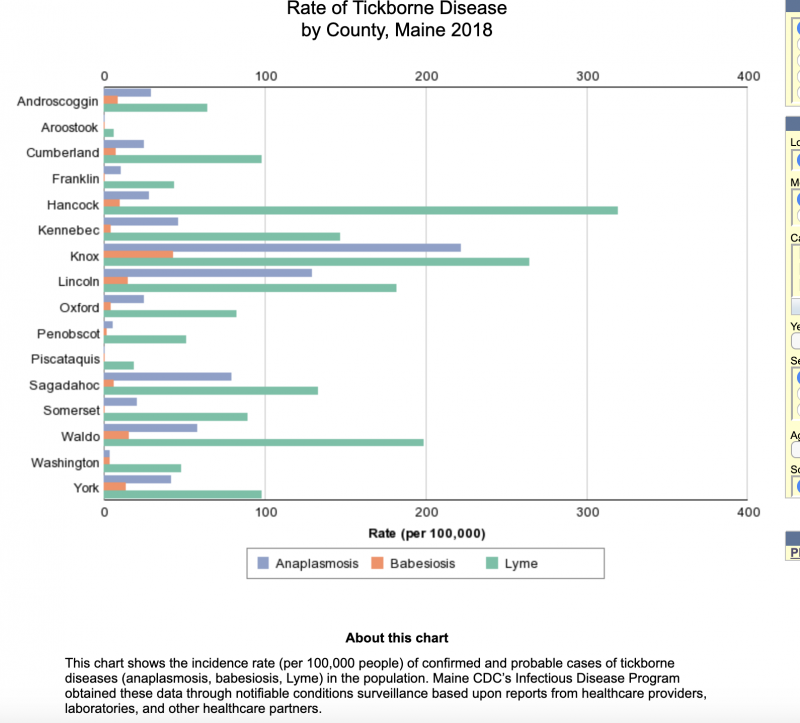
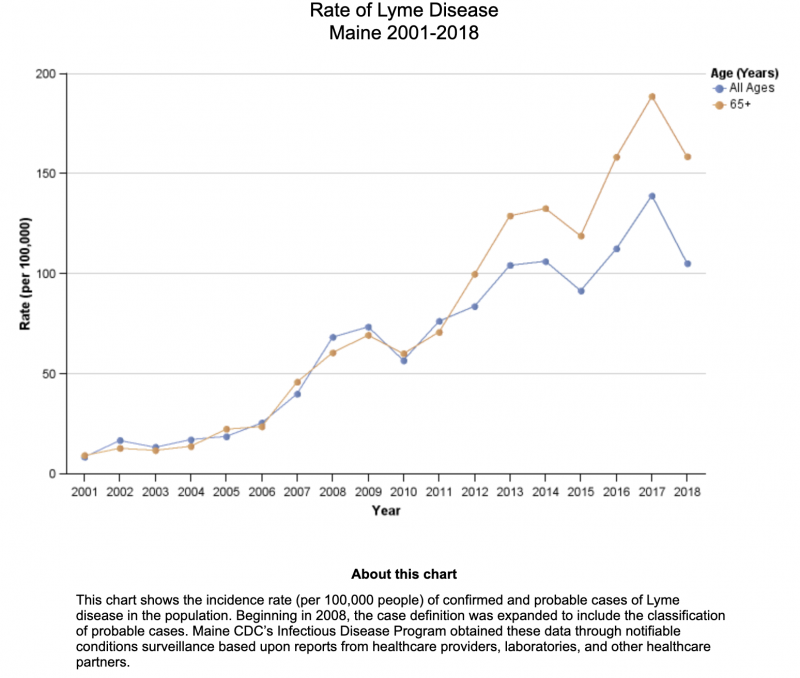
I just pulled the 5th tick of the year off my leg last night! It hadn’t embedded yet; rather it was racing up my leg to hide, tripping over my hairs and so alerting me. It reminded me that I haven’t written about ticks and the diseases they transmit in these columns since 2013! Time to review again, given that circumstances have worsened since then (Fig. 1).

Deer ticks cause Lyme disease by transmitting Lyme bacteria when they attach to their animal/human victim. They can also transmit the less common diseases (Fig. 2), anaplasmosis and babesiosis, and rarely several others (ehrlichiosis, rocky mountain spotted fever, and others Maine used to be on the edge of the deer tick/Lyme disease infestation area, the southern New England states. But with long term warming and less winter kill, ticks and deer populations have increased substantially, so it is now much more common to see tick bites and consequently increased Lyme disease incidence, especially along mid-coast Maine (Fig. 3).

Lyme disease gets its name from the coastal town of Lyme, Connecticut. In 1975, a woman reported to Yale researchers 51 local cases of pediatric arthritis, which they identified and named “Lyme arthritis".  In 1979, the name was changed to "Lyme disease" when other researchers discovered additional symptoms linked to the disease, including neurological problems and severe fatigue. In 1982 the bacteria causing the disease was discovered by Dr. Willy Burgdorfer, hence its name: Borrelia burgdorferi.

There are two common types of ticks here in Kennebec County: deer ticks, 5% of which are carriers of Lyme disease, and benign dog ticks. Deer ticks are half the size of apple seed-sized dog ticks, and lack the latters” white "racing stripes" down their backs. However, deer tick nymphs (babies), are more common this time of year, and are as small as poppy seeds, that is until they attach to people or animals and fill with blood to 10 times that size over several days. The longer a deer tick stays on, the more likely people are to contract Lyme disease, if the tick is a carrier. If they embed for fewer than 24-48 hours, disease rarely follows; most patients with Lyme disease have had a tick on for nearly a week.

Three to thirty days after a bite, the first sign of disease is usually a circular (usually over 3 inches in diameter), non-tender rash, called erythema chronicum migrans (EM), which looks like a red "ringworm" rash around a bull’s-eye bite site. The rash occurs in  70- 80% of patients.  In Maine, EM is reported in just over 50% of patients. But don’t be alarmed about the small mosquito bite-like red spot appearing at the site of the bite itself within a day or two; it just reflects the bite injury, not a Lyme infection. Fever in 60% of patients, aching body and joints (90 + %), and headache (65%) also occur as the rash reaches its peak and begins to fade. If not treated, complications involving heart, nerves, brain, and joints can occur weeks and months later. Children 5-14 and people over 65 have these the most frequently. However, Lyme disease is almost never fatal, unlike the other rarer tick-borne diseases.

So how can you avoid these troubles without moving to Northern Canada? First, the most important thing to do is use DEET-containing bug dope to discourage their climbing on you, and tucking your pantlegs into your sox, a popular new Maine fashion now. Secondly, you should check yourself and your family for ticks daily if they’ve been outside whenever the ground isn’t frozen. This can be hard on parts of the body difficult to see, like the back side of your knees or trunk. I thought I'd grown a big skin tag behind my knee for several days, until I looked with a mirror and saw it was an engorged (swollen) tick not a big blueberry! Yikes! And wash, or at least heat in a dryer, clothes worn outside that may or do have ticks on them. Keeping your lawn mown may help by giving ticks less chance to climb up higher to jump on you; and some say light colored clothing helps, but I doubt the evidence basis for that.

If you find a tick, it's not swollen, and you are pretty sure it hasn't been on for more than a couple days, there is no need to submit it to the state lab for identification or be treated; just remove it and your chances of developing disease are very small. Slow steady pressure to pull it off usually works. The best instrument for this is a “tick spoon”, a baby spoon sized tool with a split down the middle to scoop up the trapped tick. Use tweezers to pull steadily but gently for the several minutes it takes to get the tick to release; I prefer a Leatherman for the revenge satisfaction. Breaking the head off in the bite leaves some, though substantially less, risk of infection. Don't try to burn the tick off; it may be tougher than your body will tolerate.

If the tick is engorged and may have been on for several days, then call your doctor/clinician for a single preventive dose of doxycycline. It will reduce your chances of getting Lyme from an infected tick from 3% to 0.6%.

If you develop the ring rash around the bite site weeks later, or in a place where you weren't aware you'd been bitten, then you should be given a course of antibiotics for 2-3 weeks, doxycycline/tetracycline for most, amoxicillin or cefuroxime for pregnant women and children, in whom the tetracyclines are not safe. The downside of the latter alternative antibiotics is that they don't also cover the rare co-infections with ehrlichiosis, anaplasmosis, and babesiosis. You will probably need to see a doctor/clinician to evaluate any such rash; ask for an urgent appointment. Sooner rather than later treatment is important. The rare, late complications are also treated with antibiotics after being proven due to Lyme by blood test immune titers.

So, use bug dope. Check yourself and the kids. Pull ticks off before they get engorged. And get antibiotics if you develop the characteristic rash or other symptoms.

For more information about ticks and many other public health risks, check out the Maine CDC portal here  and their great section on ticks : here
Marti Gross


Martha Gross (1946 - 2019)


Martha Gross, 72, of Vienna, died Sunday May 19, 2019, at Maine General Medical Center in Augusta.

She was born in Methuen, Mass., Sept. 29, 1946, the daughter of John and Marguerite (McCarthy) Casserly.

Martha graduated Emmanuel College in 1968. She worked for many years at her husband's dental practice and more recently as the treasurer for the towns of Vienna and Mt. Vernon. Her passion for volunteering started at an early age as a candy striper and followed her later in life as she gave her time to numerous organizations and causes, such as the Union Hall Association.

Martha was predeceased by her husband, Lawrence Gross.

She is survived by her children, Michael Gross and his wife, Elizabeth, of South Portland and Rebecca Gross, of Cambridge, Mass.; her grandchildren, Jacob and Caileigh Gross of South Portland; her sister, Marie Schena and her husband, Bobby, of Haverhill, Mass., as well as several nieces and nephews.

A memorial service will be held at the Union Hall in Vienna, Maine, at 11 a.m., on June 1.

Arrangements are in the care of Knowlton and Hewins Funeral Home, One Church Street, Augusta. Memories, condolences, photos, and videos may be shared with the family on the obituary page of our website at www.familyfirstfuneralhomes.com